


CNFIA Issuance for Authenticity against Ill-founded Rumors on White Liquor
2017-04-20
At the beginning of April, a small video on rapidly distinguishing authenticity of white liquor lasting more than 3 minutes caused concerns in the white liquor industry. In the video, a man compared home-made white liquor with other two kinds of famous-brand white liquor (in which one is produced by our company), observed turbidity after adding water, and pointed out the “turbidity change” in home-made white liquor and another kind of liquor belonged to grain liquor, and the “non-turbidity change” in white liquor belonged to “fake liquor, chemical liquor, industrial liquor, and alcoholic liquor”; meanwhile drinking the non-grain liquor would cause serious discomfort such as headache and thirst etc.
In fact, the distinguishing method stated in the video has been widely spread in the white liquor industry, and some people even deeply believe this method is simple and effective. At this time, the distinguishing method was made into a video and caused a great disturbance, for the man in the video advertised his home-made white liquor but slandered the white liquor brand of our company, and such behavior suspiciously played to the gallery.
For this purpose, our company requested the Specialized Committee for White Liquor under China National Food Industry Association (CNFIA) to authoritatively authenticate the scientificity of the method so as to clarify matters to the public. After authentication and investigation, the Specialized Committee for White Liquor under CNFIA issued a document towards society, pointed out the “Judgment Methods for Turbidity of White Liquor by Adding Water and for Fake Liquor” in the video had no persuasive scientific basis, and some opinions of the man in the video were suspiciously misleading the audiences and numerous white liquor consumers.
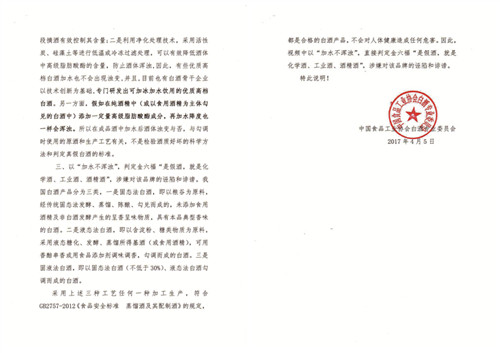
The following contents are the full text of Explanations for “Judgment Methods for Turbidity of White Liquor by Adding Water and for Fake Liquor” in the Video Widespread on Internet issued by Specialized Committee for White Liquor under China National Food Industry Association together with document screenshots:
Explanations for “Judgment Methods for Turbidity of White Liquor by Adding Water and for Fake Liquor” in the Video Widespread on Internet
Recently, the Specialized Committee for White Liquor under China National Food Industry Association (CNFIA) has received a video about “Judgment Methods for Turbidity of White Liquor by Adding Water and for Fake Liquor” widespread on the Internet from Hunan Jinliufu White Liquor Company. The Specialized Committee organized experts to review and analyze the video and here explains the fallacy, slandering and public misleading in the video as follows:
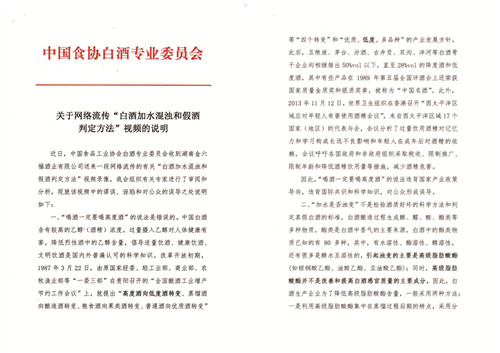
I. Wrong statement that “you must drink strong white liquor if you want to drink”
The Chinese white liquor contains higher ethyl alcohol (ethanol) concentration and excessive ethanol intake will harm body health. The widely recognized scientific knowledge at home and abroad include reduction of ethanol content in strong white liquor, and advocacy of proper drinking, healthy drinking, and civilized drinking.
State Economic and Trade Commission, Ministry of Light Industry, Ministry of Commerce, and Ministry of Agriculture, Animal Husbandry and Fishery held “Working Conference on Increasing Production and Practicing Economy for National White Liquor Making Industry” in Guiyang City on March 22, 1987. The participants put forward four transformations of “from strong white liquor to weak white liquor, from distilled liquor to fermented liquor, from grain liquor to fruit liquor, and from ordinary liquor to high-quality liquor” as well as industrial development guidelines featured by “high quality, low degree, and multiple varieties” on the Conference.
Afterwards, backbone white liquor enterprises in China such as Moutai, Wuliangye, Fen Liquor, Gujinggong, Shuanggou, and Yanghe have successively launched alcohol-reducing liquor and low-degree liquor below 50%vol and as low as 28%vol, in which some liquor products were honored with National Quality Gold Medal and Silver Medal on the Fifth National Conference on White Liquor Evaluation in 1989 and regarded as “Chinese Famous Liquor”. In addition, World Health Organization held “Conference on Harmful Use of Alcohol on Young People in Western Pacific Region” in Hong Kong on November 12, 2013. Representatives from 17 countries (regions) in the western Pacific region participated in the Conference which analyzed long-term and negative influences of excessive ethyl alcohol drinking upon memory and learning as well as the young people’s dependence upon ethyl alcohol after adulthood; and also called for national governments and non-governmental organizations adopting various measures such as taxation, promotion limitation, age limitation, and reduction of drinking amount of ethyl alcohol so as to reduce alcohol harm.
Therefore, the statement that “you must drink strong white liquor if you want to drink” violates national industrial policy guidance, goes against international consensus and scientific knowledge, and misleads the public.
II. “Judging turbidity change by adding water” is neither the scientific method to verify white liquor quality nor the standard for judging white liquor authenticity
Numerous substances will be produced such as alcohol, aldehyde, acid and esters etc. during white liquor making. The fragrance in the white liquor mainly comes from the esters. There are more than 80 known esters in the white liquor including water solubility, ester solubility, alcohol solubility, and alcohol-water intersolubility. The turbidity change is mainly caused by advanced fatty acid ester (such as ethyl palmitate, ethyl oleate, and ethyl linoleate); meanwhile the advanced fatty acid ester is not the major ingredient to improve and enhance sensory quality of white liquor.
Therefore, white liquor producers usually adopt two methods to reduce the contents of advanced fatty acid ester: Firstly, adopt segmental liquor-taking to effectively control the contents of advanced fatty acid ester based on the feature of advanced fatty acid ester concentrating in later period of distillation process; Secondly, adopt activated carbon and kieselguhr for low temperature or freezing filtration treatment through purification treatment technology to effectively reduce the contents of advanced fatty acid ester in liquor body and prevent liquor body turbidity.
Therefore, turbidity change will not occur even water is added into some high-quality and top-grade white liquor. Moreover, on the one hand, currently some backbone enterprises of white liquor take technological innovation as foundation, and particularly develop high-quality and top-grade white liquor added with ice and water for drinking. On the other hand, if certain contents of higher fatty acid ethyl esters are added into straight alcohol (or into the blended white liquor with edible alcohol as main body), alcohol content drop will also become turbid if added with water. Therefore, raw liquor and production process during blending will determine whether turbidity change occurs in liquor body after finished liquor is added with water, which shall neither be regarded as the scientific method to verify white liquor quality nor the standard for judging white liquor authenticity.
III. Judging Jinliufu White Liquor as “fake liquor, chemical liquor, industrial liquor, and alcoholic liquor” based on “non-turbidity if added with water” suspiciously frames up and slanders the Jinliufu Brand
The white liquor products in China are divided into three categories: Firstly, white liquor produced by solid fermentation, namely, cereal grains are taken as raw materials and the white liquor is fermented, distilled, aged and blended through the traditional solid fermentation; aroma and flavor-producing substances are made through non-white liquor fermentation without adding edible alcohol, and thus the finished white liquor has a typical aroma. Secondly, white liquor produced by liquid fermentation, namely, the materials containing starch and saccharides are taken as the raw materials, and basic liquor (or edible alcohol) is obtained through liquid saccharification, fermentation, and distillation; the finished white liquor is blended with flavor and aroma adjusted through flavoring fermented grains or food additives. Thirdly, white liquor produced by solid-liquid fermentation, namely, the white liquor is blended through solid fermentation (not below 30%) and liquid fermentation.
Any production through the above-mentioned three processes conforms to regulations in Food Safety Standards for Distilled Liquor and Compound Liquor (GB2757-2012), belongs to qualified white liquor and causes no harm to human health. Therefore, directly judging Jinliufu White Liquor as “fake liquor, chemical liquor, industrial liquor, and alcoholic liquor” based on “non-turbidity if added with water” in the video frames up and slanders the Jinliufu Brand.
We hereby certify the above-mentioned fact.
Specialized Committee for White Liquor under China National Food Industry Association
April 5, 2017

